


If you could choose between reclining in a window seat watching the countryside zoom by while drinking a cappuccino, reaching Florence from Milan in two hours OR picking up a rental car, navigating unfamiliar roads and toll systems, and arriving in Tuscany in about five hours from Milan, which would you pick? Most people would probably go for the quicker, more relaxed route, and that’s where Italy’s 17,000 kilometer (10,563 mile) rail system comes in.
Train travel in Italy is relatively easy and if you’re traveling between major cities, it’s almost always the more convenient way to get around. But it may pose some challenges if you have never been to the country or if you are not used to riding long-distance trains. Buying tickets, reading arrival and departure boards and finding your binario (train track) can be confusing at first, but are easily navigated with sound advice and expert information. That’s why we created this ultimate guide.
Making the case for riding the rails
Train travel is one of the easiest and most convenient ways to move around Italy. Whether you use the rails for all or part of your Italian trip depends on your itinerary. If you do a Rome-Florence-Venice tour, you’ll save time and hassle be traveling by train. If you plan to visit the countryside, the Amalfi Coast, the islands, or the mountains, you should consider renting a car for more freedom and flexibility. You can also combine different modes of transport: train between major cities, a rental car to reach smaller towns that may not be as well connected (including towns on the Amalfi Coast), and plane if you need to go from the north to the south or want to visit Sardinia or Sicily.
Tracking travel times for major cities
Rome to Florence: 1 hour 30 minutes
Rome to Naples: 1 hour 10 minutes
Rome to Venice: 3 hours 45 minutes
Bologna to Florence: 37 minute
Milan to Rome: 2 hours 55 minutes
Milan to Venice: 2 hours 25 minutes
Milan to Florence: 2 hours and 25 minutes
Florence to Milan: 1 hour 54 minutes
Florence to Venice: 2 hours
Understanding Italy’s train system
Italy’s rail network is operated primarily by Trenitalia, the national railway company. For most first-time visitors, Trenitalia will be your primary carrier, and understanding their train categories is the first step to planning your journey.
Le Frecce are Trenitalia’s most modern, comfortable and fastest trains, which also means they cost more. They require advance reservation, have seat assignments, and provide most of the high-speed service on the main lines between Turin, Milan, Venice, Bologna, Florence, Rome, Naples, and Bari.
There are three types of Frecce:
Frecciarossa: the fastest and most expensive trains, traveling up to 300 kilometers (about 186 miles) per hour.
Frecciargento: these trains use both the high-speed and regional lines; they are not as fast as the Frecciarossa and take you to main cities such as Florence, Bologna, Rome and Naples, but not to Milan or Turin. They go to Venice and southern regions like Puglia and Calabria.
Frecciabianca: the slowest among the Frecce, they run on regional lines and connect large and medium-sized cities.
Intercity are regional trains where you may or may not reserve seats in advance. With frequent stops, journey times can be double or longer. They also don’t have amenities beyond toilets.
Regional trains connect minor towns and villages but can also be used to travel to major cities — though at a snail’s pace. Coaches are mostly second class, with only one or two reserved for first. They also have basic toilets but no other amenities.
Buying an Italian train ticket
All trains generally offer first class and second class except for the regional trains. Frecce also have standard, premium, business, executive and salotto (a private room) on the fastest trains. If you wish for tranquility and silence, go for a higher tier of service, with business offering some single seats — meaning you won’t have anyone next to you. Opt for business class for journeys over two hours and standard class for shorter trips and budget travel.
Buy your ticket online in advance via the train company’s website, with an intermediary such as Italian train travel specialists ItaliaRail, or through your travel agent. Or, if you are making a last-minute trip, you can buy your ticket at the train station either at a ticketing window or using self-serve ticket machines (instructions are available in English and the machines accept credit cards).
We recommend buying your tickets in advance whenever possible to avoid lines. You’ll also have more seat options, plus having your trip mapped out beforehand can save you precious time while in Italy. Tickets are generally available four months in advance, and higher fare classes will give you the option to make same-day changes to your departure time.
As a general rule, the sooner you book, the cheaper the fare. Seniors and children (or family packages) generally have reduced fares on Trenitalia’s Frecce.
Getting to the station and on to your train
WATCH A TRAIN TRIP IN ACTION
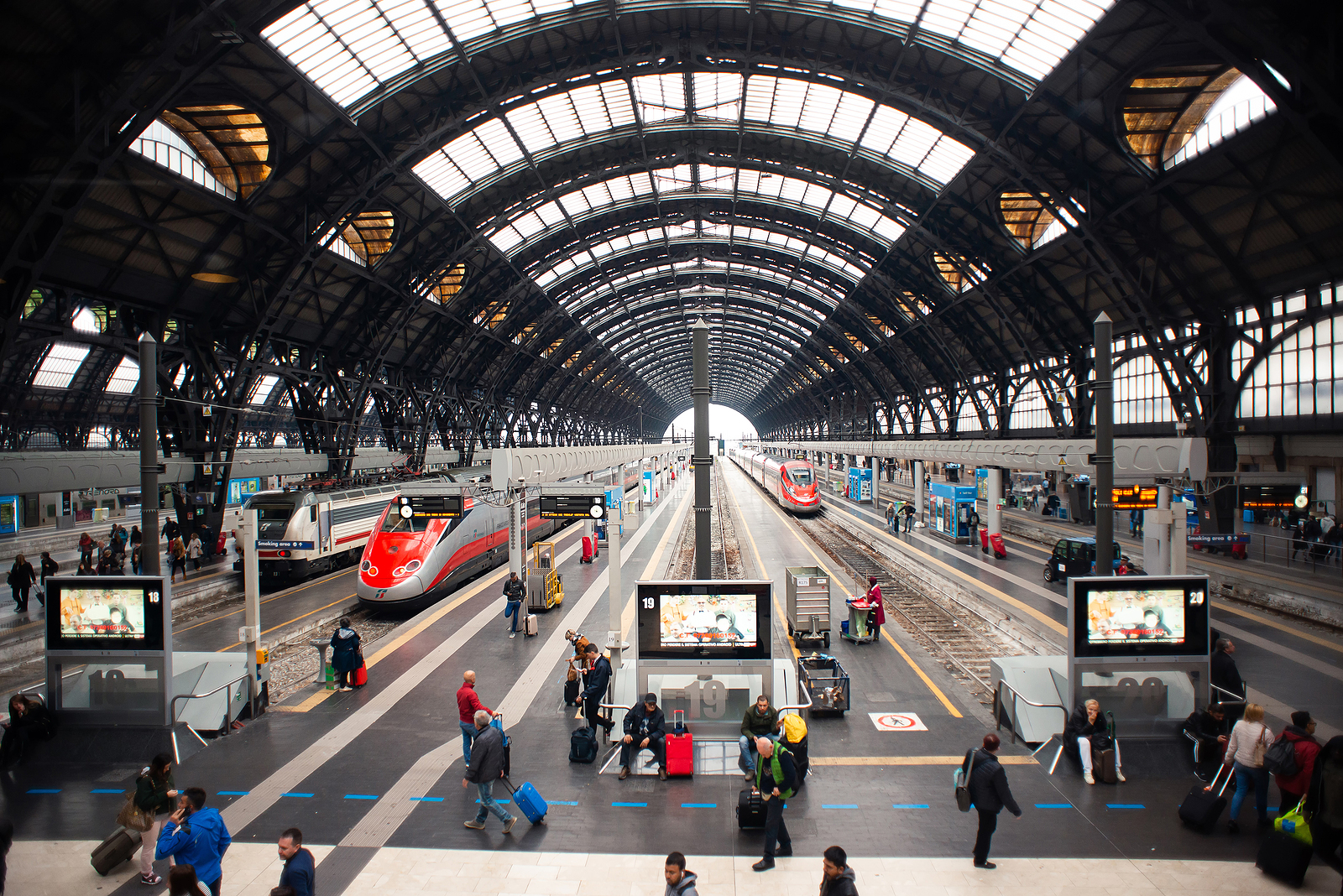
Though you don't need to arrive as early as you would if catching a flight, it's always a good idea to arrive 30 minutes before your train's scheduled departure time, especially if you're traveling through Bologna, Rome or Milan where tracks number in the dozens, and, in the case of Bologna, cover multiple floors.
Once inside, find a departures (partenze) and arrivals (arrivi) board where you'll find the following:
- Type of train and train number (treno)
- Train’s final destination (destinazione)
- Departure time (orario)
- Delay (ritardo)
- Information (informazioni) - this usually displays the intermediate stops of the train with arrival times and where the different classes are located scrolling by
- Platform number (binario)
To identify your train, look for the train number on your ticket, as the destination shown on the board is the final one, but your destination may be an intermediate stop (which you will see in the part of the display that scrolls by).
If your ticket doesn’t have a specific train number, date and time printed on it, you must validate it before boarding (e-tickets will require an online check-in or will validate automatically, depending on the type of train; check your email confirmation for instructions). Look for a green, white or yellow electronic box and insert your ticket into it to get it timestamped (i.e. validated) before getting on your train. This mostly applies to regional trains. You do not need to validate your ticket if you are taking a high-speed train; you just need to keep it close at hand.
When at the platform, double-check that the train you are about to board is the right one by looking at one of the several boards positioned overhead along the track — it specifies train number and destination.
Also, make sure to board the correct carriage for high-speed trains; the number is visible on the side of the train, on an electronic sign on the door, and before boarding, on a screen overhead. This way you will avoid creating more confusion and blocking aisles as you walk through carriages to reach your seat.
Staying safe at the train station
Generally speaking, traveling by train in Italy is safe, but be vigilant of pickpockets and other petty criminals as you board and while traveling. Always carry your bag in the front, and consider investing in a money belt for carrying your passport, credit card, money and important documents.
Luggage should be placed below the seat in front of you, in the overhead shelves, or if it’s oversized in a luggage storage by a carriage door. Do not leave your luggage or any bags unattended and be sure all luggage is locked. Thieves have been known to ride for one stop with the sole purpose of targeting distracted travelers.
Do not accept help from strangers who may offer to carry your luggage or help you get a ticket at the ticketing machine.
Managing a train delay or cancellation
Trains are sometimes delayed due to repairs on a line, and strikes are common. If your Trenitalia train is delayed by more than 30 minutes, you may be eligible for compensation. If you don’t receive an email or text message communicating this after the delay, you can contact Trenitalia customer service or visit a customer service office at the train station. If you’d rather prevent the potential hassle, book with ItaliaRail as an intermediary. ItaliaRail offers 24/7 support in English and may be able to file claims on your behalf if your trip goes south.
Packing for train travel in Italy
The lighter your luggage, the easier it will be to travel by train. You don’t want to have to carry around a huge suitcase as you search for your track, or struggle with lifting and lowering it when you get on and off the train — a smaller bag will also be easier to keep an eye on. See our packing tips for Italy for general guidelines on what to put in your suitcase.
Making your journey smoother with insider tips
Use the Frecce to reach the biggest cities, then use regionali to move around the region to smaller centers (when possible — sometimes you will need to take a bus instead; sometimes renting a car will be the easiest option).
Book tickets in advance. ItaliaRail.com offers booking in US dollars with 24/7 English-speaking support. Book early during peak travel times.
Check for delays before you go to the station. Download the Trenitalia app for real-time platform and delay information
Mind the direction of travel. Italian trains can change direction mid-route, particularly at terminal stations like Florence Santa Maria Novella. A forward-facing seat leaving Rome may face backward after Florence. Table seats (available in Business class) eliminate this concern and are ideal for couples or small groups.
Embrace the café-bar. Frecciarossa trains serve espresso, panini, wine and light meals. In Business and Executive class, attendants will bring refreshments to your seat.
Plan connections wisely. Allow at least 30 minutes between connections, especially at large stations where you may need to change platforms. If booking through ItaliaRail, their search results will only show connections with adequate transfer time.
Consider day trips. Rail transforms day trips from ambitious to effortless. Rome to Pompeii? Under two hours via Frecciarossa to Naples plus a local train. Florence to Bologna for lunch? 37 minutes. Milan to Lake Como? Under an hour. The ease of these journeys means you can base yourself in one city and explore widely.
A two-hour ride could mean seeing the calm waters of the Adriatic Coast or Liguria peeking out between jutting cliffs — traveling by train can offer another perspective of Italy and Italians. So book that ticket, find your seat by the window, and let Italy unfold before you.
For more Italian train travel, check out Italy Magazine's dedicated section Italy by Train.